What Journal Editors Look For Before Sending a Paper to Peer Review
Submitting a research paper to a journal does not necessarily mean it will reach peer reviewers. Before a manuscript is sent to external experts, it usually passes through an editorial screening stage that determines whether it is suitable for further consideration. This initial assessment can happen quickly, but it can have a major impact on a paper’s chances of publication.
Understanding what editors look for during this stage can help authors avoid preventable problems and make a stronger first impression.
1. Fit with the Journal
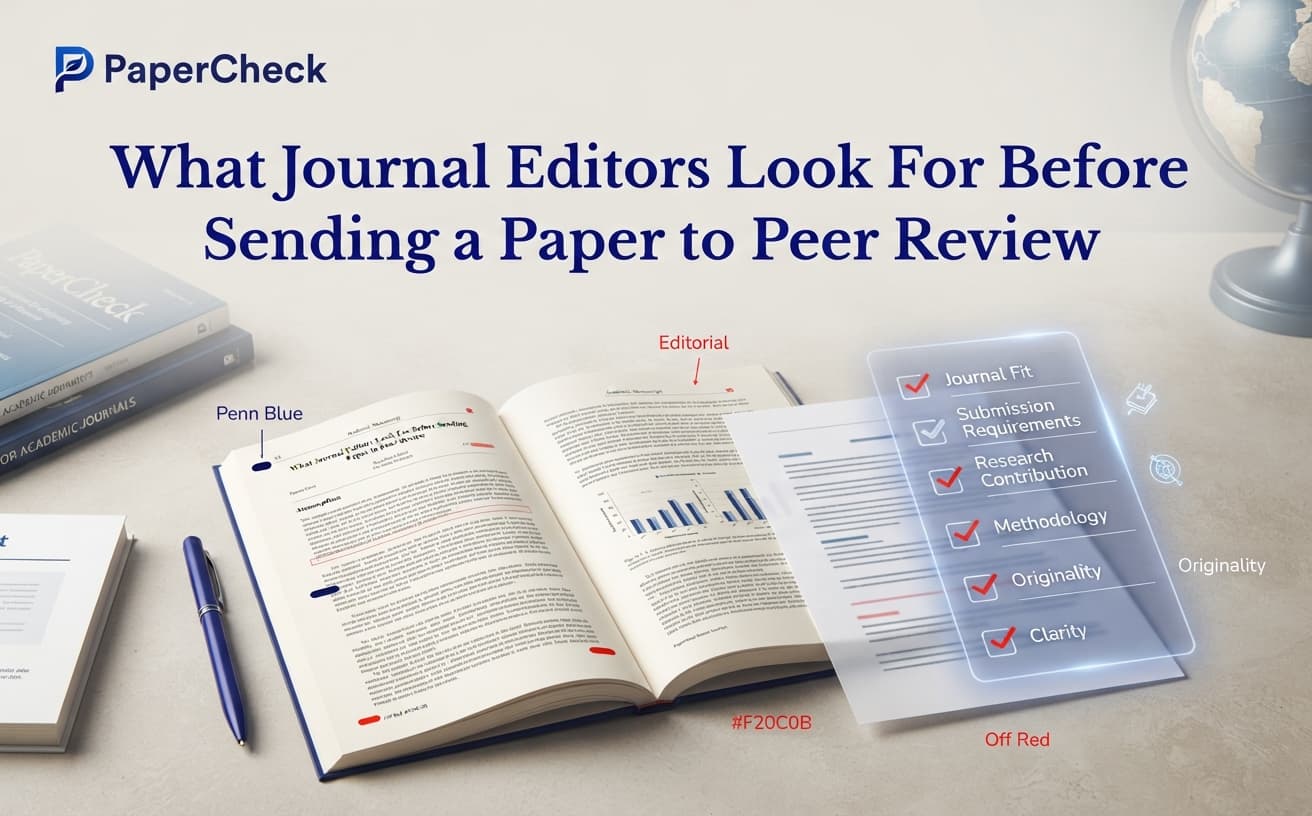
One of the first questions editors ask is whether the manuscript belongs in their journal. Editors consider the paper’s topic, research area, methodology, and intended audience in relation to the journal’s scope. A well-written paper can still be rejected before peer review if it falls outside the journal’s aims. Authors should read the journal’s scope carefully and review recently published articles to determine whether their research is a reasonable fit.
2. Compliance with Submission Guidelines
Editors also check whether authors have followed the journal’s technical requirements. These may include word limits, formatting, reference style, manuscript structure, figures and tables, supplementary materials, and required declarations. Failure to follow these instructions does not necessarily mean a manuscript will be rejected, but significant omissions or repeated noncompliance can prevent it from moving forward.
3. A Clear Research Question and Contribution
Editors need to quickly understand what a manuscript is about and why it matters. A paper should present a clear research question, purpose, or hypothesis, and demonstrate how it contributes to the existing literature. If the manuscript’s purpose or contribution is difficult to identify, an editor may decide that it is not ready for peer review.
Want a stronger first impression?
Professional editing can help make your research clearer and easier to evaluate before submission.
Get Your Quote
4. Methodological Soundness
At the screening stage, editors are not conducting the same detailed evaluation that peer reviewers will perform. Nevertheless, they generally look for obvious methodological problems. The research design should be appropriate to the research question, and the manuscript should provide sufficient information to demonstrate that the study was conducted credibly. Depending on the field, this may include information about data sources, participants, analytical methods, ethical approval, or experimental procedures.
Major methodological concerns apparent in the manuscript may result in an editorial rejection without external review.
5. Originality and Relevance
Editors also consider whether the manuscript offers something sufficiently original or relevant to the journal’s readership. They may assess how the paper differs from existing research and whether its findings or argument justify publication.
6. Clarity and Professional Presentation
Language quality can also influence an editor’s initial assessment. A manuscript does not need to be stylistically perfect, but serious grammar, spelling, structural, or clarity problems can make the research difficult to evaluate.
Poor presentation can also obscure an otherwise valuable contribution. Careful proofreading and professional academic editing can help ensure that language problems do not become an unnecessary barrier to review.
How to Pass the Editorial Screening Stage
The best approach is to evaluate the manuscript from the editor’s perspective before submitting it. Ask:
Does this research clearly fit the journal?
Have I followed every relevant submission requirement?
Is the research question easy to identify?
Is the contribution to the literature clearly stated?
Does the methodology support the research question?
Is the manuscript complete, consistent, and professionally presented?
The editorial screening stage may be invisible to authors, but it is an important part of the publication process. Treating it as seriously as the peer-review stage can improve a manuscript’s chances of making it to the experts whose feedback it needs.
Is Your Manuscript Ready for Editorial Screening?
Before submitting, make sure your research is presented clearly and professionally.
Get Your Quote