How to Prepare Your Manuscript Before Sending It to an Editor
How to Prepare Your Manuscript Before Sending It to an Editor
Before sending your manuscript to an editor, ensure it is complete, professionally formatted, and free of obvious errors to avoid delays. A well-prepared file allows the editor to focus on your writing instead of spending time fixing basic problems or searching for missing information. It also demonstrates respect for the editor’s time and increases the likelihood of a smooth editing process.
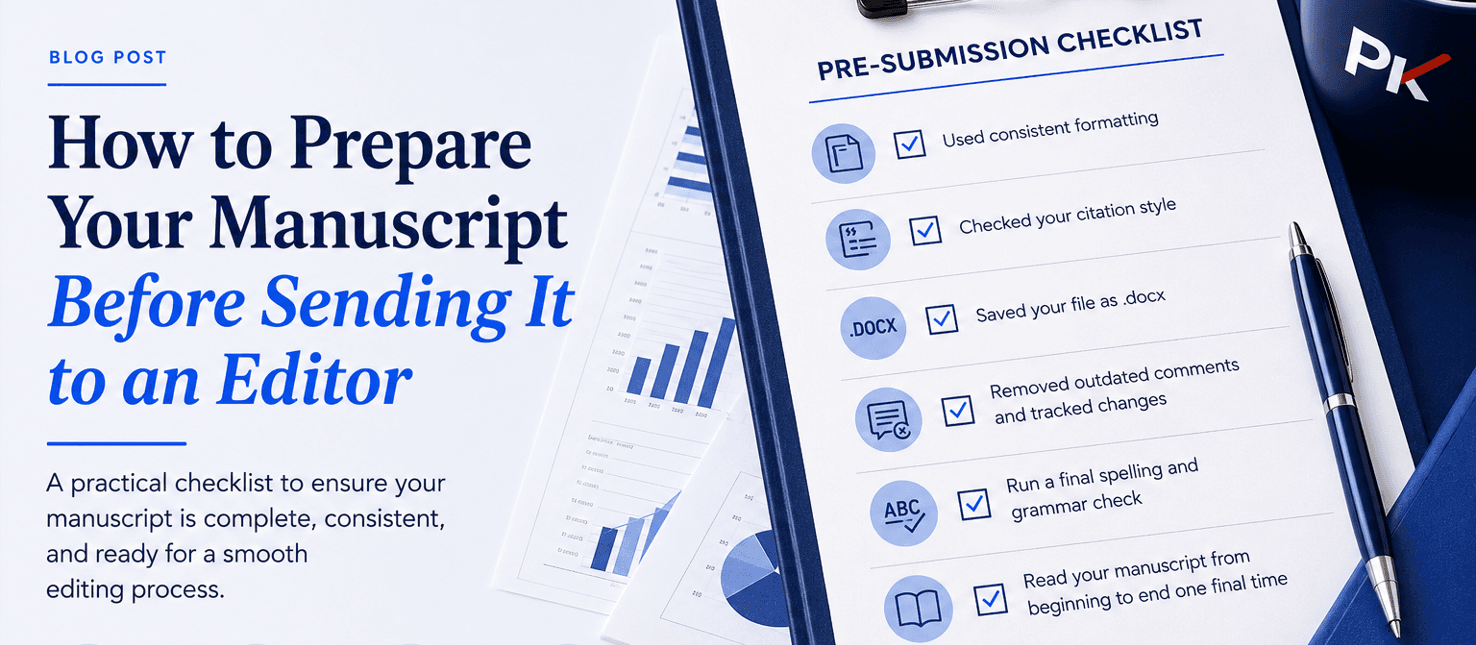
Pre-Submission Checklist
Before you upload your manuscript, take two minutes to go through this checklist:
☐ Used consistent formatting
☐ Checked your citation style
☐ Saved your file as .docx
☐ Removed outdated comments and tracked changes
☐ Run a final spelling and grammar check
☐ Read your manuscript from beginning to end one final time
1. Formatting Standards
Unless your editor, journal of choice, or institution has provided specific instructions, keep the formatting simple and consistent.
Use a standard font like Times New Roman or Arial, 12-point size, and double spacing.
Set 1-inch margins and include page numbers.
Align text to the left rather than fully justifying it.
Verify that chapter headings and page numbering are consistent throughout.
Indent paragraphs consistently and correctly (Paragraph Settings → Indentation → Special → First line). Do not use spaces to create indents.
Use built-in heading styles for chapter titles, section headings, and subheadings.
2. Citation and Reference Style
If your manuscript includes sources, confirm which citation style is required, such as APA, MLA, Chicago, or Harvard. Then apply it consistently.
Ensure every in-text citation appears in the reference list, and vice versa.
Verify all DOIs and URLs, and check punctuation, abbreviations, and ordering for consistency.
Avoid including retracted articles or unverified preprints; clearly designate preprints when used.
Do not reference AI-generated material, as it is generally unacceptable.
Check that you have permission to use any long quotations or copyrighted material when necessary.
3. File Preparation
Save your file in the format requested by the editor (often .doc or .docx).
Merge all chapters into a single, clean document; avoid sending multiple versions such as “final draft 1” or “latest final.” Also, try to avoid submitting your work in separate segments, as different editors may end up working on them and not have the full context of your manuscript.
Accept or reject old tracked changes and comments that are not longer relevant.
Run spellcheck and grammar review, but also read manually to catch subtle errors.
4. Common Mistakes That Slow Editing
Several problems can slow down editing. Common examples include:
Undefined abbreviations, variables, or technical terms.
Inconsistent terminology.
Mismatched data between the text and tables.
Using passive/active voice inconsistently or employing a tone that does not suit the academic audience.
Switching between British and American English.
Long, convoluted sentences with multiple subordinate clauses that obscure the main point and require restructuring.
Paragraphs that contain multiple unrelated ideas or lack a clear topic sentence.
Inconsistent capitalization. For example, alternating between “Figure 2” and “figure 2,” or “University” and “university” without a reason.
These issues often consume more editorial time than grammar corrections because they require the editor to interpret the author’s intended meaning, verify consistency across the manuscript, and sometimes recommend substantive revisions rather than simply correcting errors.
Before submission, read the manuscript as a complete document and confirm that the formatting and citations are correct and that the argument flows logically from the introduction through the conclusion. The manuscript does not need to be flawless before editing, but it should be complete, internally consistent, and ready for a detailed academic review.
Ready to Submit Your Manuscript?
Preparing your manuscript before editing helps you get the most value from the editorial process.
Our professional editors review academic papers, theses, dissertations, and journal manuscripts for clarity, consistency, and readability.
👉 Upload your manuscript today and receive a personalized quote.