
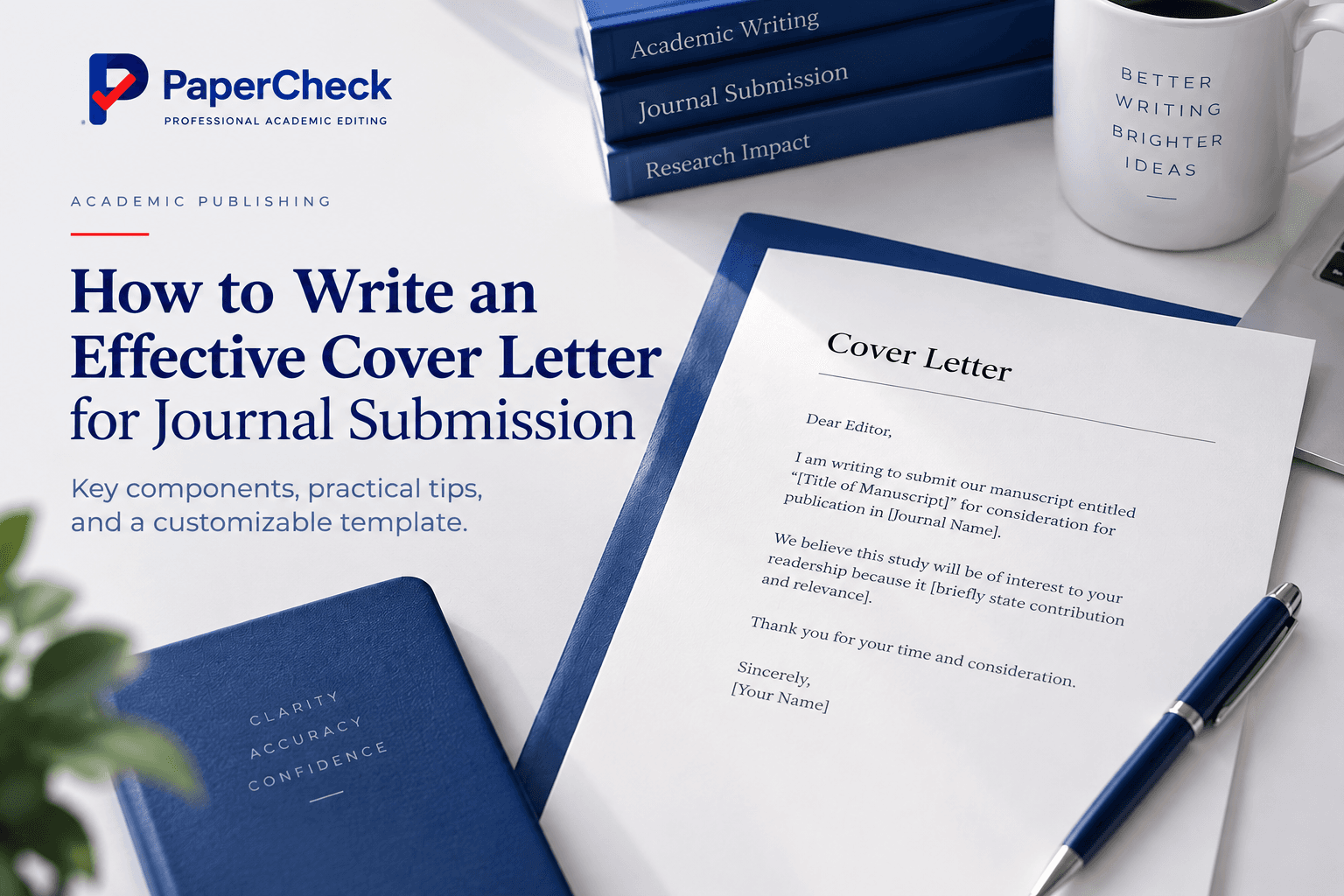
How to Write an Effective Cover Letter for Journal Submission
How to Write an Effective Cover Letter for Journal Submission
Submitting a manuscript to an academic journal involves more than uploading a file and completing an online form. In many cases, authors are also asked to provide a cover letter introducing the manuscript to the editor. Many authors treat the cover letter as a minor administrative hurdle before peer review begins. However, journal editors read your cover letter first; a well-crafted cover letter can help an editor quickly understand what the paper contributes and why it is appropriate for the journal.
Writing an effective cover letter does not require dense jargon or overly poetic prose. Nor is it supposed to be a summary of the entire manuscript. Instead, it should provide the essential context that an editor needs to decide whether the submission is suitable for the journal and ready for peer review. It demands clarity, conciseness, and a professional tone that highlights your manuscript’s value.
Key Components of a Strong Cover Letter
Most journal cover letters can be organized into five main elements:
1. Formal Header and Greeting
Address the editor-in-chief or handling editor by name whenever possible. If not, “Dear Editor” is appropriate. Avoid generic phrasing like “To Whom It May Concern” or overly personal openings.
2. Introduce the Manuscript
State the manuscript’s title, article type (e.g., original research article, review, short communication), and the fact that you are submitting it for consideration. You can briefly identify the subject of the study, but there is no need to reproduce the abstract.
3. Key Findings, Academic Significance, and Scope Alignment
This is usually the most important part of the letter. In two or three sentences, explain what the study contributes and how it aligns with the journal’s scope. Focus on the broader significance of your work: What research gap does this study address? Why are these findings important now? How does this work advance the field?
4. Mandatory Declarations
Journals often expect authors to confirm that the manuscript is original and is not under consideration elsewhere. Depending on the journal and the study, the cover letter may also need to mention ethical approval, conflicts of interest, permissions, or other relevant declarations.
Not every journal has the same requirements, so always check the journal’s submission guidelines and follow any instructions about information that must be included in the cover letter.
5. Close Professionally
End by thanking the editor for considering the manuscript. Include the corresponding author’s contact information if requested by the journal.
Practical Tips for Success
Keep it concise. Aim for a single page (approximately 300 to 500 words). Editors review hundreds of submissions; brevity demonstrates respect for their time.
Tailor it to the journal. Mention the journal by name and explain why the manuscript belongs there. A letter that could be sent unchanged to ten different journals is unlikely to demonstrate a strong understanding of the target publication.
Balance your tone. Use formal academic English. Avoid casual phrasing (e.g., “our results were super surprising”), but do not weigh down sentences with unnecessary jargon.
Highlight the contribution, not the adjectives. Instead of describing the study as “highly significant” or “groundbreaking,” explain what it contributes. Let the research support its own importance.
Follow journal guidelines. Always check the journal’s “Instructions for Authors” before finalizing your letter. Some publications require specific disclosures, such as suggested reviewers or funding sources.
Proofread before submitting. The cover letter is often the editor’s first direct encounter with your writing. Spelling errors, incorrect journal names, inconsistent manuscript titles, or copied text from another submission can create an unnecessarily poor first impression.
Need a polished manuscript before submission?
Professional editing can help you improve clarity, consistency, and presentation before your paper reaches the editor.
Customizable Cover Letter Template
Use the following template as a structural foundation for your submission.
[Your Name]
[Your Academic Title/Affiliation]
[Institutional Address]
[Email Address]
[Date]
Dear Dr. [Editor’s Last Name],
I am writing to submit our original research manuscript titled “[Exact Title of Manuscript]” for consideration for publication in [Journal Name] as an [article type (e.g., original research article)].
In this study, we examined [briefly state the central research problem or question]. Using [brief reference to methodology or approach], we found that [summarize 1–2 key results or theoretical insights]. These findings contribute to the literature by [explain the study’s primary novelty or significance].
We believe this manuscript is well-suited for [Journal Name] because [explain alignment with the journal’s scope and target readership]. Given your publication’s recent focus on [relevant topic or theme], our findings offer valuable insights for researchers interested in [field/discipline].
We confirm that this manuscript is original, has not been published previously, and is not currently under consideration for publication elsewhere. [Include any additional statement specifically requested by the journal, such as information about ethical approval, conflicts of interest, or permissions.]
Thank you for your time and consideration of our work. We look forward to hearing from you.
Sincerely,
[Your Signature]
[Your Title and Institution]
Ready to Submit Your Manuscript?
Make sure your writing is clear, polished, and ready to make a strong first impression.