How to Choose the Right Academic Editing Service (And Not Waste Money)
Choosing an academic editing service can feel surprisingly uncertain, especially for researchers submitting important work. Most services promise polished language, fast delivery, and professional results, but once the edited document comes back, the quality can vary quite a bit. Sometimes the corrections are helpful. Other times, the manuscript returns with cleaner grammar but the same structural problems, unclear arguments, or awkward flow that were there before. In some cases, the editing feels so generic that it barely improves the reading experience at all.
Part of the problem is that “editing” can mean very different things depending on the service. Some companies focus mainly on surface-level corrections: grammar, punctuation, spelling, and formatting. Those things matter, of course, but academic writing often requires more than technical cleanup. A paper can be grammatically correct and still be difficult to follow. Arguments may feel disconnected, sections may lose focus, or terminology may be used inconsistently across the manuscript.
That difference becomes important when the paper is heading toward peer review or publication.
Low-cost editing services often rely on speed and volume. The review may be partially automated, heavily template-based, or assigned to editors without much familiarity with academic writing itself. The result is usually readable, but not necessarily stronger. A useful academic edit goes beyond correcting sentences individually, it looks at how the paper works as a whole. Sometimes that means tightening repetitive sections. In other cases, it means adjusting transitions so the argument develops more naturally. Good editors also notice when a paragraph technically makes sense but still feels confusing from a reader’s perspective. That kind of revision requires attention, context, and actual human judgment.
What to Look for in an Academic Editing Service
 Good editing improves readability, clarity, and presentation—not just grammar.
Academic editing also requires some level of subject familiarity. Different disciplines follow different conventions, and an editor should be able to recognize when terminology, structure, or tone feels unclear within an academic context.
Turnaround time matters too. Extremely fast services sometimes rely heavily on automated corrections, which can improve grammar while missing issues related to flow, argument, or nuance. A sentence may be technically correct and still sound unnatural in the paper itself.
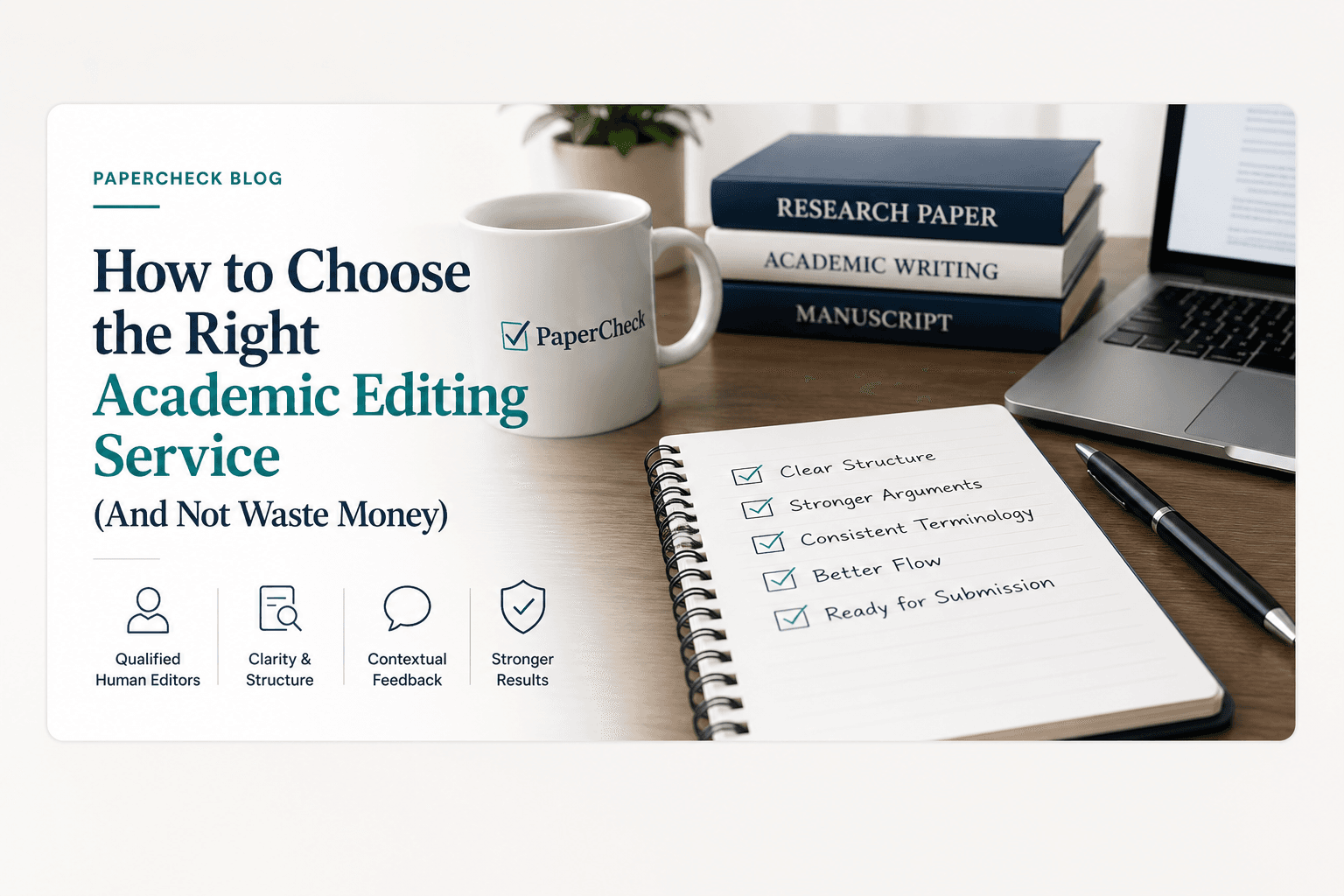
Professional academic editing should improve more than grammar. Strong editing helps researchers communicate ideas clearly, improve readability, and prepare manuscripts for submission.
👉 Explore our academic editing services.
For that reason, it helps to check who is actually reviewing the manuscript and what kind of editing is included. Strong services usually combine human review, contextual feedback, and transparent communication rather than simple error correction.
Services like PaperCheck stand out because they focus on clarity, readability, and academic presentation—not just grammar fixes. A good edit should still sound like the original writer, only clearer and more polished.
Ultimately, choosing an editing service is less about finding the cheapest option and more about making sure the research is presented as clearly and professionally as possible.
Choosing the right editing service can make a major difference in how your research is received.
At PaperCheck, our human editors focus on clarity, structure, readability, and academic presentation — not just grammar corrections.