Copyediting vs Substantive Editing vs Proofreading: What’s the Difference?
Researchers often know that a manuscript needs “editing” without knowing what kind. That distinction matters. Proofreading, copyediting, and substantive editing address different problems, and choosing the wrong service can mean paying for help that arrives too early—or too late. The terminology can also vary between editors and companies, so it is always worth checking what a service actually includes before purchasing it.
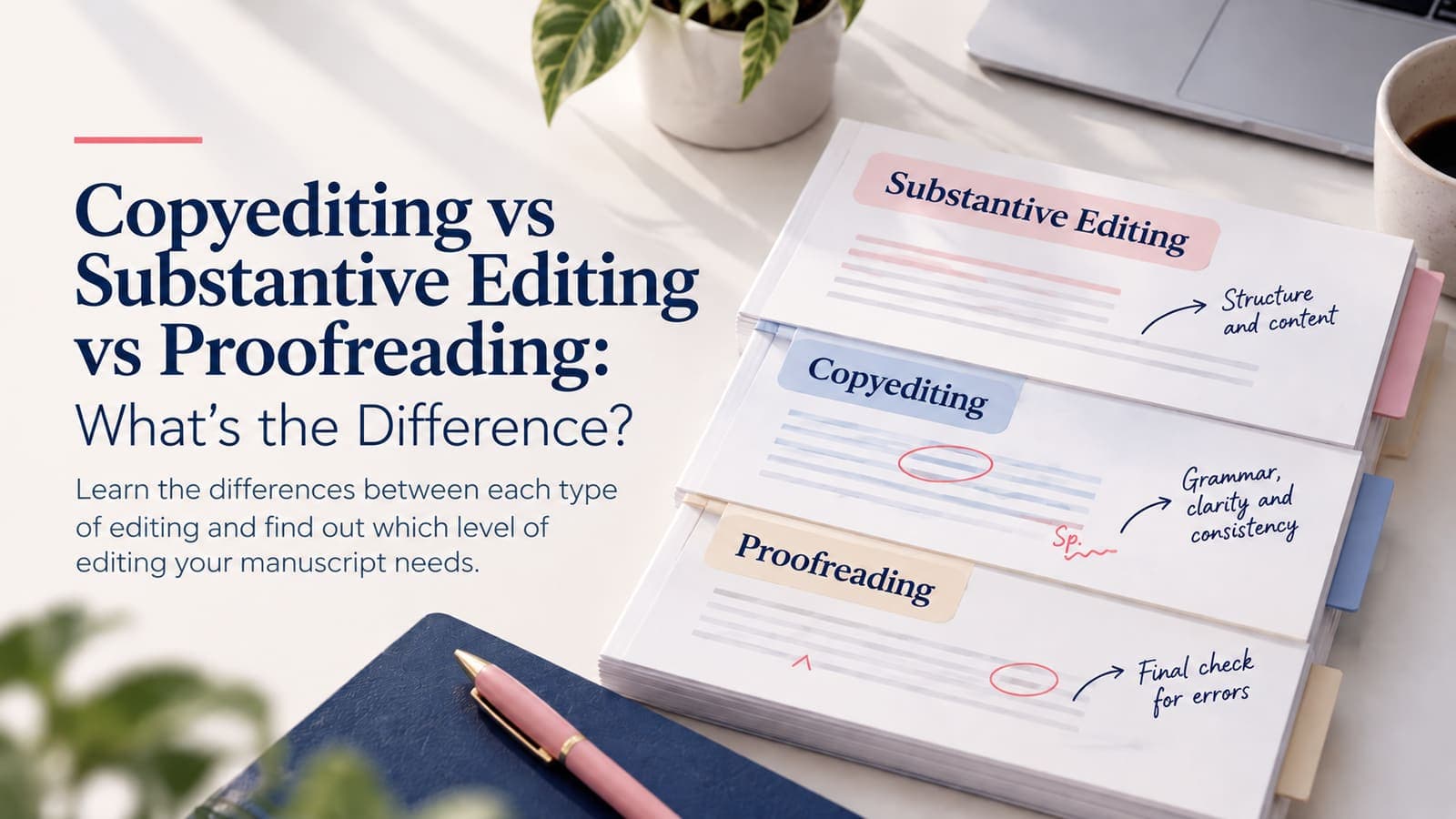
Substantive Editing: When the Paper Needs Big-Picture Work
Substantive editing works at the level of the manuscript as a whole.
An editor may look at the organization of sections, the logic of the argument, repetition, gaps in the discussion, or whether certain material belongs elsewhere. They may recommend cutting, expanding, or moving content when doing so improves the paper’s overall coherence.
For researchers, this level of editing is most useful when the ideas are there but the manuscript is not yet working as a complete paper.
For example, your literature review may dominate the article, the Discussion may repeat the Results, or the central contribution may not become clear until several pages into the manuscript.
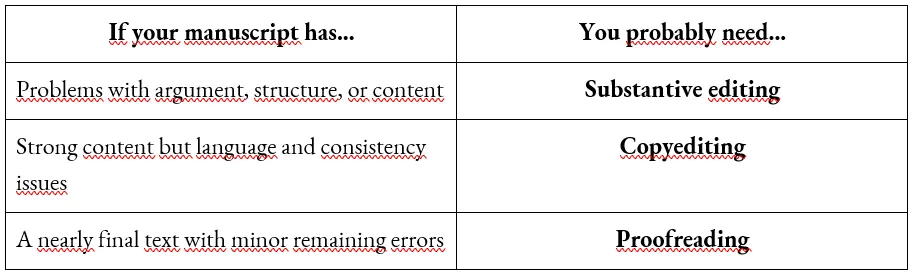
If the main problem is what the paper says and how its ideas are organized, substantive editing is usually the closest fit.
Copyediting: When the Ideas Work but the Writing Needs Attention
Copyediting generally begins after the larger structural decisions have been made.
Here, the focus shifts to the text itself: grammar, punctuation, spelling, word choice, sentence clarity, consistency, and editorial style. Depending on the service, the editor may also check terminology, headings, tables, figures, and references for internal consistency.
Imagine that the argument is already strong, but the manuscript contains awkward sentences, inconsistent capitalization, recurring grammar problems, or different terms for the same concept. These issues may not require the paper to be reorganized, but they can still make it harder to read.
That is where copyediting becomes useful.
Proofreading: When the Manuscript Is Almost Finished
Proofreading comes much later in the process.
It is a final quality check designed to catch errors that remain after the manuscript has already been written, revised, and edited. These may include typos, punctuation slips, formatting inconsistencies, incorrect headings, caption errors, or small problems introduced during final preparation.
Proofreading is therefore not simply a lighter version of substantive editing.
If the argument is unclear or an entire section needs restructuring, a proofreader is seeing the manuscript too late to solve the real problem. Proofreading works best when the text is already close to its final form.
Not sure which editing service your manuscript needs?
Our editors can help you identify the right level of support for your paper.
Which Level of Editing Do You Need?
 Ready to improve your manuscript?
Get professional academic editing tailored to the stage your paper is in.
One Manuscript May Need More Than One Stage
These services are not always alternatives. The same paper may go through substantive editing first, copyediting later, and proofreading shortly before submission or publication.
What matters is the stage your manuscript has reached.
Before hiring an editor, ask what they will—and will not—change. Two services with the same name may have different scopes, and understanding that difference can prevent mismatched expectations.
If the argument still needs work, proofreading is probably too late. If the structure is already solid, substantive editing may be more intervention than the manuscript needs. Choosing the right service starts with identifying the kind of problem you are actually trying to solve.