Can AI Really Write Your Academic Paper? What Every Researcher Should Know
Can AI Really Write Your Academic Paper? What Every Researcher Should Know
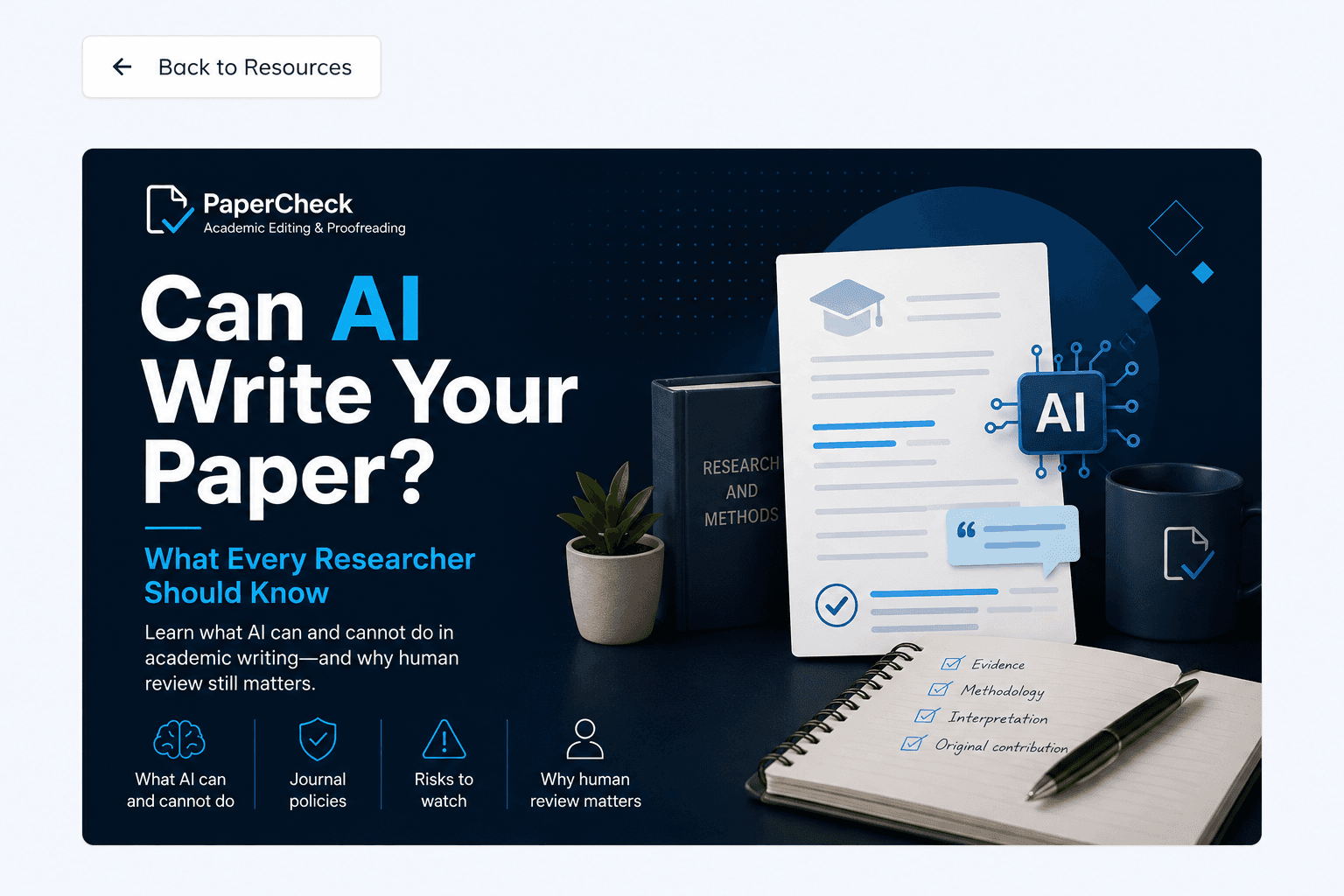
As generative AI becomes increasingly common in research and higher education, many researchers are asking the same question. AI can draft paragraphs, improve wording, summarize information, and even generate text that sounds convincingly academic.
But writing a research paper involves much more than producing polished sentences. Every manuscript represents decisions about evidence, methodology, interpretation, and scholarly contribution, responsibilities that remain with the researcher.
In this guide, we'll explore what AI can and cannot do in academic writing, the risks researchers should understand, current journal policies, and why careful human review still plays a critical role before submission.
What AI Can—and Cannot—Do in Academic Writing
Used carefully, AI can support several parts of the writing process. A researcher might use it to explore possible ways to organize a section, simplify an awkward sentence, improve readability, or brainstorm alternatives when a paragraph is not working. For authors writing in a second language, these tools can also be useful during early language revision.
The boundary becomes less clear when the tool starts doing the intellectual work rather than supporting it. Asking AI to improve the wording of an argument you developed is very different from asking it to decide what your findings mean or generate a discussion section from your results.
That distinction matters because the final paper must represent the author’s reasoning. AI can produce a sentence about a finding. It cannot assume responsibility for whether the interpretation is scientifically justified.
AI in Academic Writing: Support vs. Responsibility
 The middle column deserves particular attention. AI-generated summaries and paraphrases can sound accurate even when important nuance has disappeared. The same problem applies to literature searches and citations. A convincing reference is not necessarily a real one, and a real source does not necessarily support the claim an AI system associates with it.
Check the Journal Policy Before You Submit
There is no single AI policy that applies to every academic journal. Publishers and professional organizations continue to develop their rules as the technology changes.
Some journals permit generative AI for limited writing assistance but require authors to disclose how it was used. Others impose additional restrictions depending on whether AI contributed to text, figures, analysis, or other parts of the research process. Major publishing guidelines also agree on an important point: an AI system cannot be listed as an author because it cannot take responsibility for the submitted work.
For researchers, the safest habit is simple: check the current author guidelines of the journal you intend to submit to. Do this before submission—and preferably before relying heavily on generative AI during manuscript preparation.
A policy followed for your last publication may not necessarily apply to the next journal.
The Risks Researchers Should Take Seriously
One of the most familiar problems with generative AI is its ability to provide incorrect information with considerable confidence. In academic writing, that becomes especially risky because polished language can make an inaccurate statement look credible.
References require particular care. Generative systems can produce incomplete bibliographic information, associate a source with a claim it does not support, or generate a reference that does not exist. Every AI-assisted citation therefore needs to be checked against the original publication.
Plagiarism and attribution raise another issue. AI-generated wording does not remove the author’s responsibility to ensure that material taken from other sources is appropriately acknowledged. Researchers remain responsible for the originality of the manuscript they submit, regardless of which tools were involved in preparing it.
There is also the question of confidentiality. Uploading unpublished research, sensitive information, or portions of a manuscript to an external platform may have implications depending on the tool’s privacy terms and the journal’s policies. Researchers working with confidential material should consider this before copying their work into any generative system.
None of these concerns means AI has no place in academic writing. They simply make verification part of the process.
Can AI Detectors Prove a Paper Was AI-Written?
AI detection adds another layer of uncertainty. Detection systems can identify patterns associated with machine-generated writing, but their results should not automatically be treated as proof of authorship.
False positives remain possible. Formal academic prose can naturally contain some of the characteristics associated with AI-generated text: consistent sentence structures, predictable transitions, technical vocabulary, and an impersonal tone. Heavily edited writing or work written by multilingual researchers may also complicate interpretation.
Even Turnitin, one of the most widely used detection platforms, acknowledges the possibility of false positives and treats lower AI-detection ranges with additional caution.
This creates an important distinction for researchers: passing an AI detector does not prove that AI was used responsibly, just as being flagged does not by itself establish academic misconduct.
Questions of authorship and research integrity cannot be reduced to a percentage.
Why Human Review Still Matters
AI-assisted writing needs human review for a reason that goes beyond grammar.
Someone still has to determine whether a statement accurately reflects the data, whether a citation genuinely supports a claim, and whether a rewritten sentence has quietly changed the author’s intended meaning. Researchers also need to consider how individual sections work together. An introduction, method, results section, and discussion cannot be evaluated as unrelated pieces of fluent prose.
This is where careful human editing remains valuable. An editor can assess clarity and consistency across the manuscript while recognizing that the research itself belongs to the author. More importantly, the researcher remains the final decision-maker.
Human review should therefore not be treated as a quick proofreading stage added after AI has finished writing. It is what keeps accountability inside the research process.
So, can AI write an academic paper? It can certainly generate something that looks like one.
The more important question is whether the final manuscript represents the researcher’s own evidence, reasoning, and scholarly contribution. AI can support drafting, organization, and language revision, but it cannot take responsibility for accuracy or research integrity.
Before submitting AI-assisted work, researchers should understand their journal’s policy, disclose AI use when required, verify every source and factual claim, and carefully review the final manuscript themselves. Used within those boundaries, AI can be a useful writing tool. It should not become the researcher behind the paper.
Ready to Submit Your Manuscript?
Whether you wrote your paper independently or used AI as part of your writing process, a final human review can help improve clarity, consistency, and readability before submission.
Upload your manuscript today and let our editors help you prepare it for publication.