What Happens After You Submit Your Manuscript for Academic Editing?
What Happens After You Submit Your Manuscript for Academic Editing?
You upload your manuscript.
A few minutes later, it disappears into an editing queue.
But what actually happens before it comes back filled with suggestions and comments?
Once your manuscript has been submitted, the work begins behind the scenes. Unless you've used an academic editing service before, it's not always clear what happens next, or what your editor is actually doing.
Professional academic editing goes far beyond correcting grammar. It involves a careful review of your manuscript to improve clarity, consistency, and readability while preserving your ideas, discipline-specific terminology, and academic voice.
What Happens Behind the Scenes?
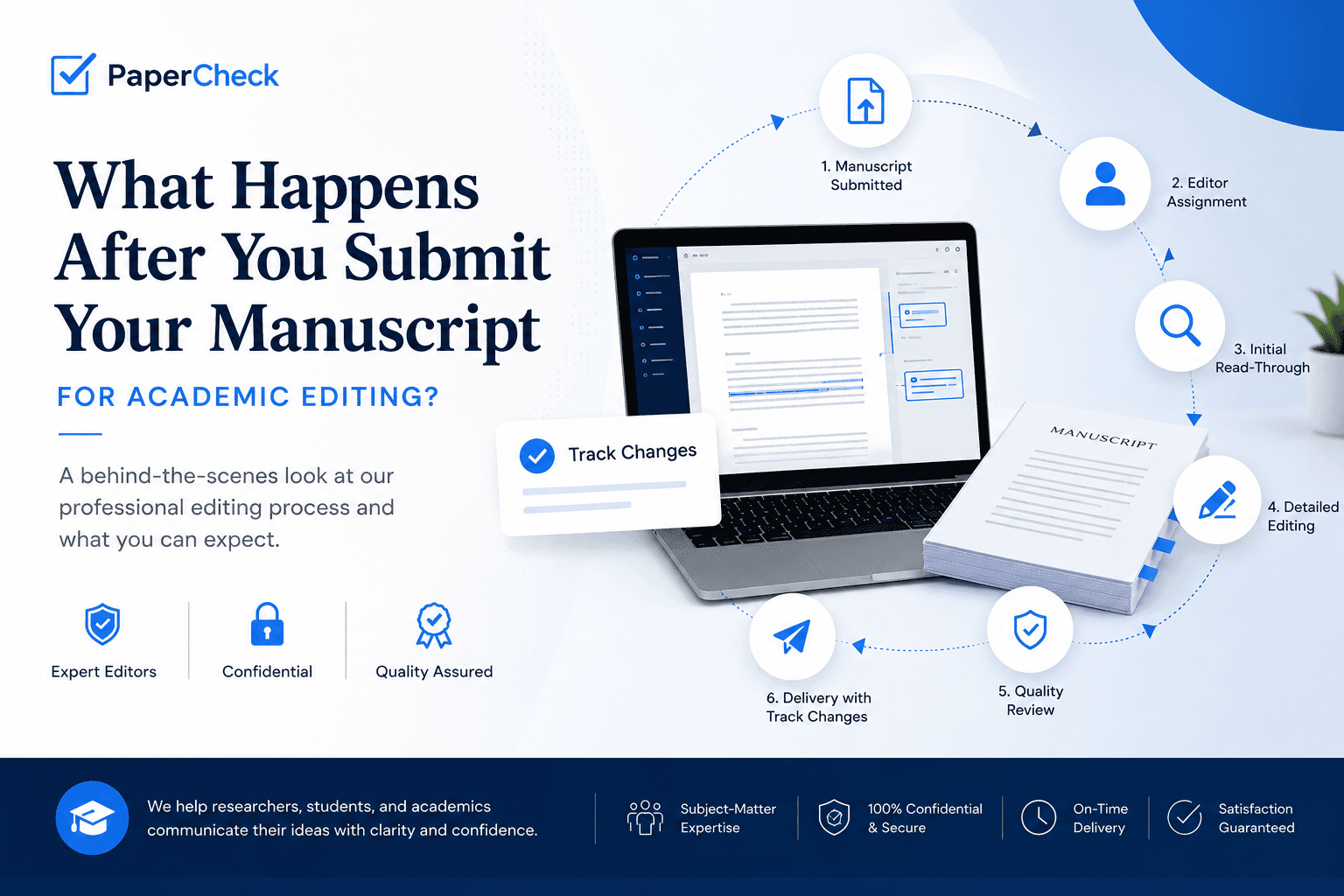
Every manuscript follows a structured editorial workflow designed to improve clarity while preserving your academic voice.
📄 Manuscript Submitted
↓
👤 Editor Assignment
↓
🔍 Initial Read-Through
↓
✏️ Detailed Editing
↓
✅ Quality Review
↓
📤Delivery with Track Changes
At PaperCheck, every manuscript is assigned to an editor based on the subject area, document type, and requested service.
The Editing Process Begins
The first step is understanding the manuscript as a whole. Before making individual corrections, an editor needs to see how the paper is organized, how the argument develops, and whether the writing communicates those ideas clearly.
Only after that broader reading does the detailed editing begin. Sentences are reviewed for grammar, punctuation, word choice, and style, but the focus goes beyond technical accuracy. An editor also looks for repeated ideas, awkward transitions, inconsistent terminology, and places where the meaning may not be immediately clear to a reader.
This is one of the biggest differences between academic editing and automated proofreading tools. A sentence can be grammatically correct and still interrupt the flow of an argument or create confusion because it lacks context. Good editing addresses those issues without changing the author’s intended message.
Whenever possible, the goal is to preserve the writer’s voice. Academic editing is not about rewriting a manuscript into someone else’s style. Instead, it aims to make the existing writing clearer, more consistent, and easier to follow.
Before the Manuscript Is Returned
Editing does not end with the last correction.
Once revisions have been completed, editors typically review the document again to make sure the changes work together as a complete manuscript. A paragraph rewritten early in the process may affect the flow of a later section, or a revised term may need to be updated consistently throughout the paper.
This final review helps catch small inconsistencies that are easy to miss during detailed editing. It is also an opportunity to ensure that comments, suggested revisions, and tracked changes are clear enough for the author to understand.
By the time the manuscript is ready to be returned, the objective is not simply to produce a cleaner document. It is to provide revisions that authors can follow with confidence as they prepare for submission.
What You’ll Receive and How to Use It
Many first-time authors expect to receive a document with every suggested change already accepted. In reality, most academic editing services return the manuscript with tracked changes so authors can see exactly what was revised.
This approach gives authors full control over the final version of their work. Instead of wondering what was changed, they can review each suggestion individually and decide whether to accept it. Comments may also appear where additional clarification or attention could improve the manuscript.
For many researchers, this becomes part of the learning process. Looking through the edits often reveals recurring writing patterns, making future manuscripts easier to draft and revise.
Rather than accepting every change immediately, it is worth taking time to read through the edited document from beginning to end. Most revisions are straightforward, but reviewing them carefully helps ensure the final manuscript still reflects the author’s intentions and discipline-specific terminology.
Academic editing works best when it is viewed as a collaboration rather than a simple correction service.
Editors bring an outside perspective to the manuscript. Because they were not involved in writing the paper, they are often able to identify places where readers may become confused, where ideas need smoother transitions, or where language unintentionally distracts from the research.
Ready to Submit Your Manuscript?
Whether you're preparing a journal article, thesis, dissertation, or research paper, our professional editors are here to help you improve clarity, consistency, and readability while preserving your academic voice.
Upload your manuscript today and receive a personalized quote from our editorial team.