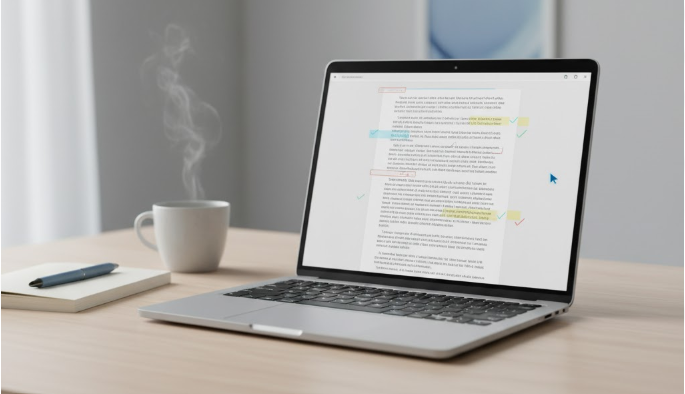

Making Sense of Reviewer Feedback: How to Revise Your Manuscript Effectively
Receiving reviewer feedback is rarely a neutral experience. Even when comments are constructive, the first reaction is often defensive. A sentence that points out a gap in the argument can feel like a broader judgment on the entire piece. That reaction is normal, but it is not always helpful. What matters more is what happens after that initial moment.
Once the emotional response settles, the feedback tends to look different. Comments that seemed overly critical at first often turn out to be more specific than expected. A reviewer is usually responding to what they encountered as a reader: confusion in a paragraph, a missing step in the reasoning, a section that feels out of place. For that reason, it helps to resist the urge to start revising immediately. A better approach is to read all the comments first, without making changes. Not quickly, and not with the intention of responding right away, but simply to understand the overall picture. Individual remarks can feel isolated when taken one by one, yet patterns tend to emerge when they are read together.
Sometimes several comments point to the same issue from different angles. One reviewer may mention that a section feels unclear, another may ask for more explanation, and a third may question the conclusion drawn from it. Taken separately, these might seem like minor observations. Together, they suggest that the underlying idea has not been communicated as clearly as it could be. Seeing those patterns makes it easier to decide what actually needs revision. Not every comment requires the same type of response. Some are straightforward and can be addressed with small adjustments—clarifying a sentence, correcting a term, adding a missing reference. Others are more structural. They may involve reorganizing sections, expanding an argument, or rethinking how ideas connect. These changes take more time, but they also tend to have a greater impact on how the manuscript is received.
There are also cases where a suggestion does not fully align with what the writer intends to say. That does not mean the comment should be ignored. Even when a specific recommendation is not followed, it often points to something worth reconsidering. If a reviewer misunderstood a section, for example, the issue may not be the reader, but the way the idea was presented.
Revision, then, is not just a matter of applying corrections. It is closer to re-reading the manuscript from the outside. This shift in perspective is not always easy, especially when the text has been developed over a long period. Familiarity can make it harder to notice where explanations are incomplete or where transitions rely too much on what the writer already knows.
Working through the manuscript slowly helps. Some sections may need to be rewritten rather than edited. Others may benefit from being shortened. It is not unusual to find that a paragraph that seemed necessary during drafting no longer adds much to the argument. Removing or reshaping it can improve the overall flow more than adding new content. At the same time, it is important not to approach revision as a purely technical task. Grammar and wording matter, but they rarely address the main concerns raised in feedback. When reviewers comment on clarity or structure, they are usually responding to how the text feels as a whole, not just to individual sentences. Focusing only on surface-level corrections can leave deeper issues unresolved. Another part of the process involves responding to the reviewers themselves. This step is sometimes treated as a formality, but it plays a role in how the revision is understood. A clear and respectful response helps show that the feedback has been taken seriously, even in cases where the manuscript has not been changed exactly as suggested.
The tone of these responses matters more than their length. It is usually enough to explain what was revised and why, or, if a suggestion was not followed, to clarify the reasoning behind that decision. For example, a brief note such as “This section has been expanded to clarify the argument” or “We have retained the original structure but clarified the transition between paragraphs” can be sufficient. The goal is not to defend every choice, but to make the revision process visible.
Over time, working with feedback becomes less about correction and more about interpretation. Not all comments carry the same weight, and not all require the same type of response. The challenge lies in distinguishing between what needs to change and what needs to be explained more clearly.
That distinction is not always obvious on the first read. It develops through careful attention to how the manuscript is being received.
In that sense, reviewer feedback is not separate from writing; it is part of it. A manuscript rarely reaches its final form in a single pass. It evolves through reading, responding, and adjusting, often more than once. The process can feel repetitive, but it is also where much of the refinement happens.
What begins as a set of external comments gradually becomes a clearer version of the text itself.